Dungeons & Drinks
A Roguelite action + tavern management dual-loop F2P mobile game. The combat loop (Roguelite) provides materials and currency; the management loop (Tycoon) converts resources into permanent combat upgrades and passive income. The two loops feed each other. I designed the entire Tycoon management system and event system.
Dual-Loop Economy Design
The core structure is a mutual-feeding relationship between two loops:
- Combat → Management: Players earn materials and currency through Roguelite combat (3 daily runs). Every 20 waves of enemies drop materials with increasing value, used for tavern upgrades and expansion.
- Management → Combat: Tavern upgrades provide permanent combat stat boosts (ATK, HP). Hired employees each have a signature drink that serves as a one-time consumable in combat, providing unique abilities. The tavern also generates passive income for further upgrades.
Design intent: combat provides short-term excitement and challenge; management provides long-term growth and relaxation. The rhythms complement each other, preventing fatigue from either loop alone.
Tycoon System Design
Employee System
Each employee has a unique signature drink used as a one-time combat consumable with different buffs. Employee unlocks and upgrades are driven by combat materials, creating a "fight → unlock → fight better → unlock more" positive feedback loop.
Upgrade System
Tavern facility upgrades cost materials and currency, providing two types of returns: permanent combat stat boosts (direct power increase) and passive income boosts (accelerated resource accumulation). Upgrades require real-time waiting, creating natural pacing checkpoints.
Tiered Economy Balance
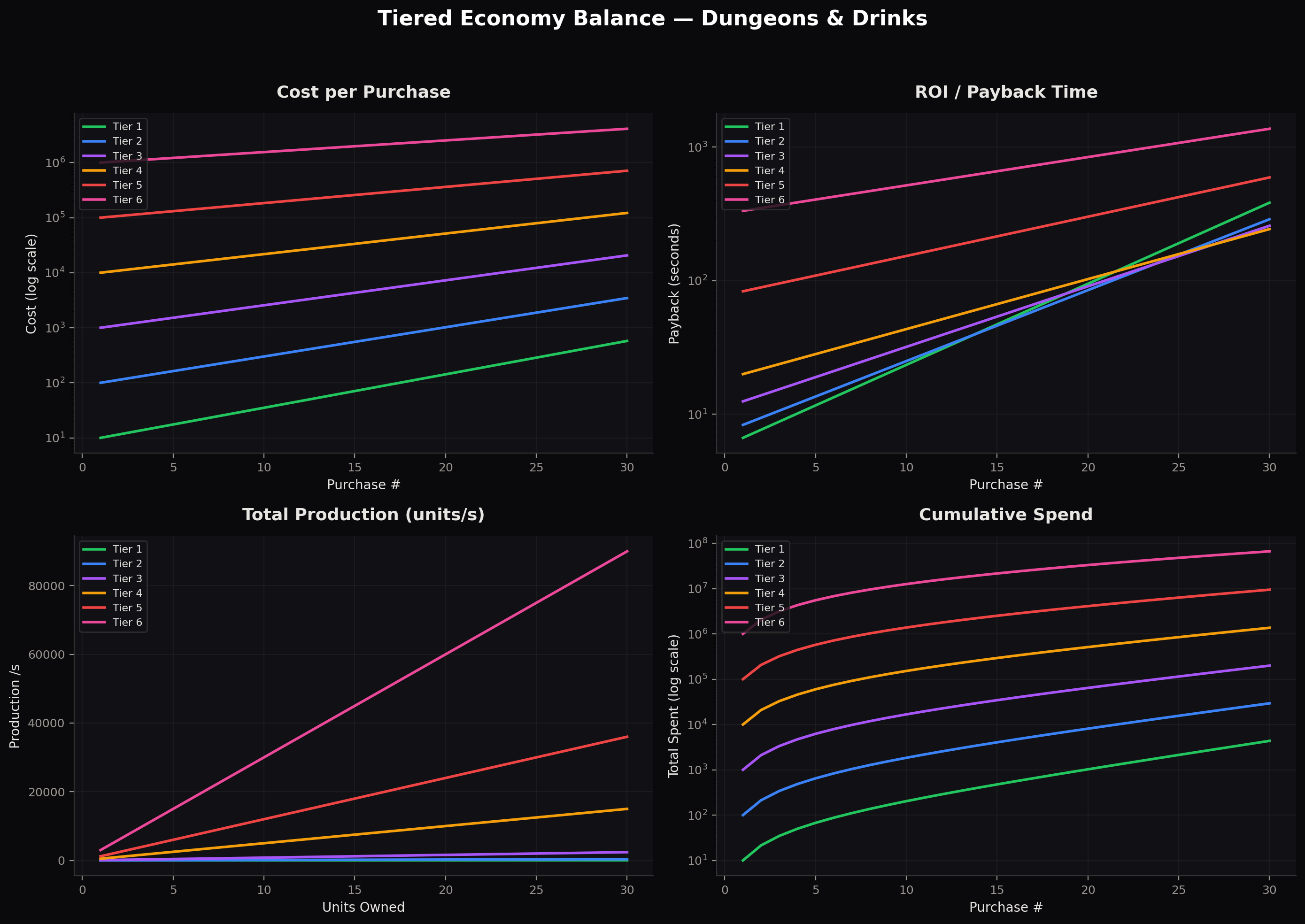
The Tycoon upgrade system uses a 6-tier progression structure. Each tier's purchase cost, output efficiency, and ROI are quantitatively designed to ensure clear decision rhythms at every stage.
Design logic: low tiers (1-2) have fast payback and low entry cost, but ROI degrades sharply with repeated purchases. High tiers (5-6) require large upfront investment and slow payback, but marginal returns decay more gently. This naturally creates a "stop buying low tier → save for high tier" decision inflection point, forming a healthy idle game loop.
Monetization Checkpoints
Three core monetization points are embedded in the Tycoon system, each targeting a different player motivation:
- Daily combat limit (3 runs/day, purchasable extra runs) — progression-driven
- In-combat revive (paid) — frustration-driven
- Upgrade time skip (paid) — patience-driven
Event Design — The Infernal Happy Hour
I independently designed a 7-day limited-time event with a complete event loop, progression plan, player segmentation, and monetization strategy.
Event Loop
The event introduces exclusive event currency (Lava Coins), limited-time enemies (fire-type), limited-time drinks (Hellfire Drinks), and exclusive rewards. The event loop nests on top of the core dual-loop: complete Infernal Challenges for Lava Coins and hell ingredients → brew Hellfire Drinks for combat/management buffs → spend Lava Coins for limited rewards.
7-Day Progression
New content unlocks daily to maintain freshness: Day 1 new recipe, Day 2 new ingredient, Day 4 Boss fight, Day 7 limited employee unlock. Free daily login rewards guarantee baseline retention.
Player Segmentation
Differentiated completion targets designed for three tiers of player engagement:
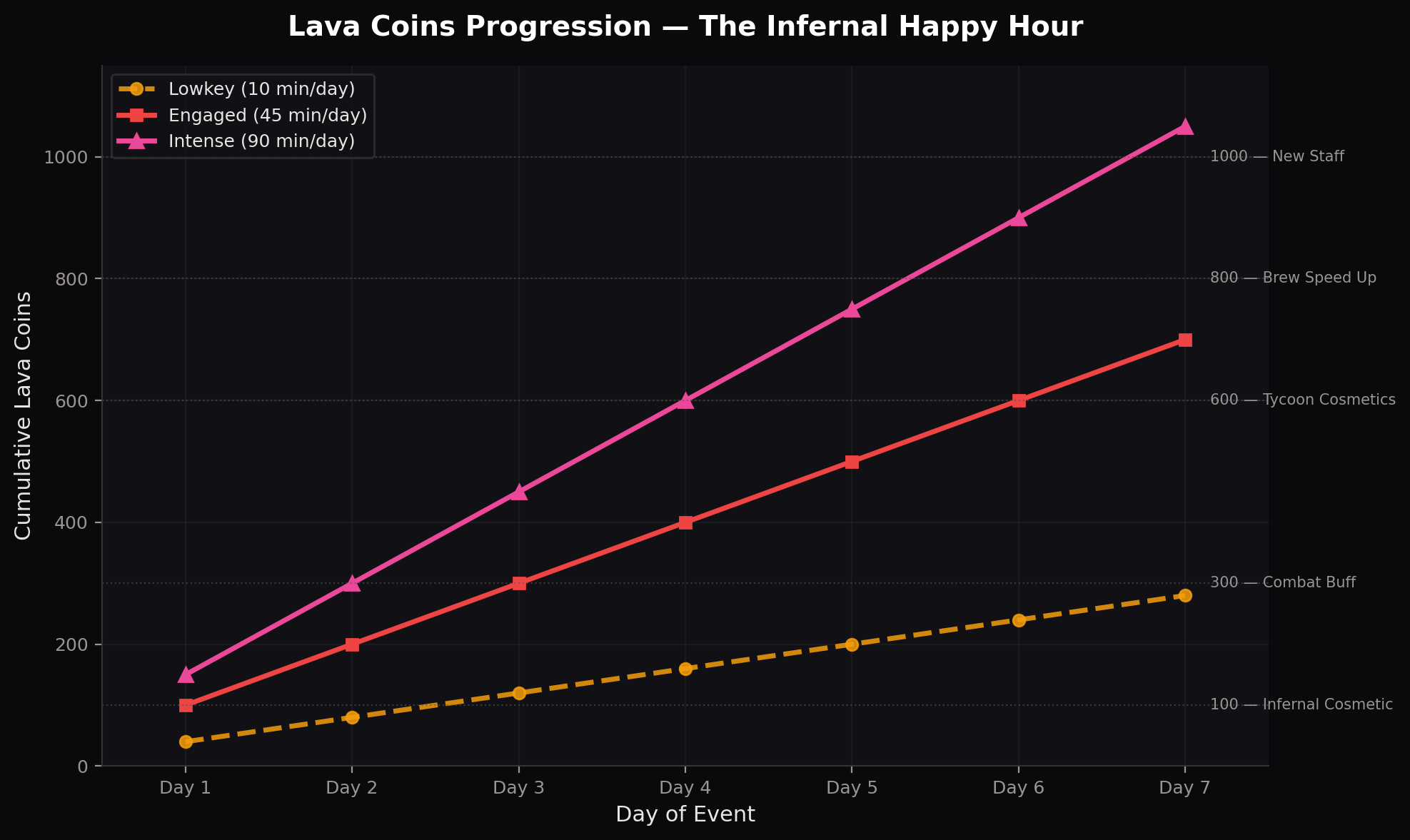
Design goal: Lowkey players can earn core rewards without feeling excluded. Engaged players complete all event content exactly. Intense players finish early and collect everything for extra satisfaction.
Event Monetization
Infernal Pass ($4.99): double Lava Coins + exclusive reward track. Brew acceleration (paid skip of 2-hour wait). Monetization does not block the free player's core experience — paying players get acceleration and extra collectibles.
FTUE — First Time User Experience
Designed and implemented the complete new player onboarding flow. The FTUE guides players through the core dual-loop — first a tutorial Roguelite run to earn materials, then the tavern management basics — establishing the rhythm before releasing players into the full game.